Showing posts with label yoga. Show all posts

Sunday, May 19, 2019

Pratyahara -The stage of Thoughtlessness

In Pratyahara, the mind is totally made silent or thoughtless detaching from all subjects and objects and prepared for the next stage of Dharna, in which the mind is concentrated on various energy centres and from that the aspirant enters the final stage of Dhyan or meditation.

[caption id="attachment_33456" align="alignnone" width="1024"]Pratyahara Pratyahara[/caption]

Pratyahara

The main objective of Pratyahara is to train the mind to be thoughtlessness. The mind must stay away from different feelings, emotions and thoughts. The body must be without action and the mind must be at peace and free of thought. This state of mind and body is called Pratyahara.


How can one keep the mind without thinking of a state?

There was no correct answer to this question. After practising and analyzing several existing methods, techniques and procedures, a systematic method has been successfully developed. The same procedure is followed here.


Consider the following phenomenon. If the electricity suddenly falls at night, it is dark everywhere. There's nothing to see. And when the power is restored, the darkness disappears immediately. The example clearly shows that there was brightness before the darkness and also after the darkness of the room. Similarly, there is a small space-time between a thought and the next thought.


This very small period between the two thoughts, which can only last a second, corresponds to the unreflective mental state. Thoughts. The space-time between the thoughts is the Pratyahara time. This requires great commitment and full attention.

How to do Pratyahara


The body is held comfortably while sitting or lying down. The mind observes the thoughts it contains for a time as mere testimony. Then the mind concentrates on breathing. As concentration concentrates on breathing, other thoughts gradually diminish.


After the thoughts have slowly focused on the breath, the respiratory consciousness must also be reduced and finally abandoned. This is the mental state thoughtlessness.


During practice, one or more thoughts may come to mind. The professional must be strict enough at this stage to expand the state of no thought between two thoughts. Even the idea of not thinking should not be in your head. It is neither a distraction, nor an unconscious state, nor a dream state. It is the absence of reflection, that is, a state of zero activity or total silence.


This is one of the most difficult states in yoga science. It can be achieved through regular practice every day. If something is to be written on the blackboard, the blackboard is cleaned first.so is the case of the mind. All the thoughts are to be removed from the mind. This is the silence or Pratyahara. In short, the mind is kept clean through the process of Pratyahara for better results in the next steps.


Saturday, May 18, 2019

Dharana, Benefits,How to do, Speciality

Dharana is a yogic practice that enhances your concentration. Without concentration, you can not do any work. Even in normal work, such as eating, drinking, reading, writing, speaking, listening, walking, etc., concentration is required.


In the various schools where Dharana is taught, different procedures are used, such as Tratak, kriya, mantra, breathing awareness. The consciousness that sits in front of an image or idol of a deity and focuses the mind on it, concentrating the mind in different energy centres in the body, etc.

[caption id="attachment_33420" align="alignnone" width="4396"]Dharana Dharana[/caption]

In our meditation class, Dharana follows the following process: the result of continuous research over many years. During this long time, the following four body parts were eventually identified as centres of energy generating.

  • The navel is the centre of physical energy for the whole body. The vital energy generated in the navel is transmitted to the whole body through 72,000 channels of energy. Concentrating on the belly button helps develop physical energy.

  • The hole below the throat is the centre of mental development. Here thoughts are generated. You get to Manovaha Nadi's brain and the relative action begins. By concentrating the mind in this pit in the throat, we develop psychological powers such as memory, concentration, will power and self-confidence.

  • Develop thinking skills and improve knowledge. This is also known as the "Agnya Chakra" centre to give instructions to various parts of the body. The concentration of the mind in the middle of the eyebrows will help to sharpen the intellect.

  • The hole below the middle of the chest is the centre of spiritual development. This is also called the lotus heart, behind is the main residence of the soul, The spirit. By focusing the mind in this centre, you develop spiritual powers.


When the mind concentrates regularly on the four previous points of the body; Physical, mental, intellectual and spiritual progress is beginning to happen.

There are three types of process in Dharana ;

The first one:

In the initial stage, it is necessary to concentrate the mind on the four centres;

  1. Bhrukuti-the centre between the eyebrows.

  2. The pit below the throat.

  3. The lotus heart in the centre in the chest.

  4. The navel.


The mind should feel their existence for some time. This feeling is the first step in it.

How to do Dharana:


1. Either in laying or sitting position, half of Bhrukuti between the eyebrows is touched for a while with the tip of the right index finger. You feel the sensation of touch. The finger is removed. However, try to feel your finger for a while. This feeling is called the concentration of the mind in the centre, which sharpens the intellect.

2. The right forefinger touches the pit below the throat for some time. The feeling of the touch is felt. The finger is taken off, and it is tried to continue the same feeling of touch ( without the touch of the finger) is called concentrating the mind on the centre that develops the psychological power.

3. Putting all the right fingers and the thumb, come together. The point fingers are placed in the small hole in the centre of the chest the lotus heart and the touch can be felt. After a while, the fingers are removed from this place and we try to feel the touch. This is called the concentration of the mind at the centre of spiritual power.

4. The bunch of the right fingers is placed on the navel and the touch is felt. After some time, the fingers are taken off from the navel. The feeling of the touch should be continuous for some time, though the fingers don't touch. This is called concentrating the mind on the centre of physical energy.

After a regular exercise, with and without contact, you can feel the direct concentration of the mind in the energy centres. First, you should feel the touch at each point for 2 to 3 minutes. This attempt should be repeated 3-4 times. Regardless of the energy needed between the previous four, the mind must concentrate on this particular energy centre for a longer period of time.

The Second Step:

In the second stage, the centre of the four energies makes a special experience felt through the mind. It is an act of mental visualization. I think that mental feeling is how we see it with our eyes open.

How to do:

1. The centre of the eyebrows is connected with the intellect and the intellect is connected with knowledge. Knowledge is supposedly light. The sun is the source of light. It is advisable to focus the mind in the middle of the eyebrows and visualize the scene of the rising sun. After a few days of uninterrupted experience of sunrise, the rays of the golden sun are felt on the entire forehead. This process shows the expansion of knowledge at every moment, just as sunlight illuminates every moment.

2. The psychic power is centralized in the pit below the throat. The mind is associated with joy and happiness. Happiness is indicated by a beautiful green colour that resembles the green of the rice fields. The mind must concentrate on the pit and make visible a green belt, a sign of joy and happiness around the neck. It helps to feel happier.

3. The spiritual power is unlimited as the sky is. The sky is blue. The mind is concentrated on the lotus heart in the pit on the centre of the chest. It should be tried to visualize that the sky blue is spreading all over the chest. This experience of visualization increases the spiritual power of the aspirant.

4. The physical energy is indicated by the flames of the fire and the flames of the fire are indicated by a bright orange-red colour. The mind is concentrated in the centre of the navel and one tries to see a bright red circle around the navel, which resembles the colour of the flames of the fire. This feeling increases physical energy.

After experiencing gradually, one after the other feelings are felt in the mind. Initially, the required colours may not be felt at all, there is no need for disappointment. Continuous practice helps in getting the desired results in a few days.

The third step:

The above(a) intellectual, (be) psychological, (c) spiritual and (d) physical energies are linked with the supreme energy, The God in this third stage. The aspirant has to visualize the all-pervading Supreme Energy in the for, of Om symbol in each of the above four energy centres, in specific size and colour. This is a further extension of the above- second step.

How to do:

  1. The golden and pink rising sun appears and feels in the middle of the eyebrows. If you leave the sun in the background, the bright red Om symbol appears in the sun's circle. It is the union of intellectual energy with the highest energy.

  2. If you place concentration on the pit in the centre of the throat, the green belt should be visualised all over the neck. The OM symbol, the size of a dark green thumb, should be visible in the throat. It is the union of psychological energy with the highest energy.

  3. The sky blue colour should be felt spreading all over the chest. The symbol Om of two inches in size in dark blue colour should be visualized on the lotus heart. This is the union of the spiritual energy with the Supreme Energy God.

  4. The bright red circle should be felt around the navel. The symbol OM of half an inch in size in dark brown colour should be felt on the navel. This is the union of the physical energy with the Supreme Energy.


According to the choice of the practitioner, any other symbol such as Swastik, Semicircle, Crescent, Cross, Star..etc.. may be used in place of OM. Even the figure of the favourite deity may be visualized of in place of Om. They should be felt in the above-referred size and colour.

The symbol can be felt seen either from the inside of the body or from the outside.

It is expected that the practitioner, following the above kriyas of the concentration, will acquire the skill of developing the intellectual, psychological, spiritual and physical powers and try to reach the highest peak in the meditation and successfully feel the Bliss of the Supreme.


Tuesday, April 30, 2019

Shankha Prakshalan Benefits, How to do and Precautions

Excretion of stool is a very essential aspect of health protection. The digestion of the eaten food is very important. There should be neither indigestion nor constipation. The yoga exercises that help in this regard is Shanka Prakshalan.


The anus is in the shape of Shankh a conch. The cleaning activity is called Prakshalan. Therefore the cleaning of the anus is called Shanka Prakshalan.

Shankh prakshalan kriya is the most important process among all the Yogic cleaning kriyas, meant for the complete internal cleaning of the body. This is an activity, which is to be processed with great care. There are four asanas that are to be postured to get maximum benefit in this regard. Before practicing the asanas, saline warm water is drunk so that 30 to 40 ft long canal from mouth to anus is cleaned thoroughly.

As we require more to clean a Zigzag tube than a straight tube, similarly we require more water to clean the zigzag passages in our abdomen. This entire water is to be pushed into the stomach through the mouth, from the stomach to small intestine, from the small intestine to large intestine and from the large intestine to the rectum. All the undigested particles of food and other accumulated wastes are pushed forward and conveniently let out along with the water through anus.

Before attempting to Shankh Prakshalan, 5 to 6 liters of warm water either with one percent of salt or juice of 5 to 5 limes mixed should be kept ready.

The Following four asanas are to be practiced in their order for Shankh Prakshalan kriya.

  1. Sarpasan

  2. Urdha hastasan.

  3. Kati chakrasan and

  4. Udar akarshanasan.


Every time before attempting these asanas one glass of salted or limed warm water is drunk.

Principles you should remember before doing Shankh prakshalan kriya.

  1. The above four asanas are to be practiced regularly for at least one week, before undertaking Shankh Prakshlan kriya. So that during prakshalan the asanas are exercised conveniently with ease.

  2. Three days before undertaking Shank prakshalan, Gaja karni or Jala dhauti kriya should be practiced every morning before breakfast. This practice helps in drinking enough water during prakshalan and there will not be any vomiting sensation.

  3. Nothing should be eaten after 4 pm a day earlier of undertaking Shankh prakshalan. Liquids may be taken if one feels so.

  4. It takes half an hour to one hour for the completion of Shanka prakshalan kriya and the salted or limed water cannot remain warm so long. Therefore the water should either be warmed at intervals or hot water is added so that warmth is maintained while drinking.

  5. Those who don't have the feeling of exerting the motion even after having 8- 10 glasses of water, further drinking of water should be stopped for some time and the whole body should be r9olled on the floor for some time. This will accelerate the main kriya.

  6. After the completion fo the prakshalan some salt water remains in the stomach. To get it out, Jala dhauti kriya is done using 5 to 6 glasses of fresh warm water without any salt.

  7. After Jala dhauti, Jala neti kriya should be done.

  8. Every machine is lubricated when it is overhauled. Similarly after cleaning the internal parts of the body, pure ghee is to be consumed compulsorily. That completes the overhauling of the body.

  9. Before undertaking Shakh Prakshalan, pudding with 100 gm of rice, 100 gms of moong dal with a pinch of salt is cooked and kept ready. After the Shank Prakshalan is completed 75 gms of pure ghee is throughly mixed in the pudding and eaten belly full. The same pudding is prepared for lunch and for the supper. On the whole, nearly 250 gms of ghee is to be consumed on that day.

  10. The ghee produces energy in the body. Nothing should either to be eaten or drunk on that day expect the prescribed pudding, Tea, coffee, milk, curd, buttermilk, fruits, curries, tobacco, alcohol, paan, pickles, and smoking must strictly be avoided for minimum 3 days after the kriya. A little water may be taken. Light food is to be taken on the second and third day along with 15o gms of ghee respectively.

  11. Bath can be taken before starting the prakshalan process. After Shankh prakshalan, the bath should not be taken.  Soon after the process, clothes are changed. The pudding should be eaten within 45 minutes.

  12. All the parts of the body become very delicate when shankh prakshalan kriya is undertaken. Therefore 24-hour rest must be given to the body and mind. Complete rest is a must, no work should be attempted during rest. One should get up only either to eat the food or to attend the calls of naute. Physical rest on the following 2 days is much preferable. Fans or air conditioning should be avoided.

  13. PErsons suffering from an ulcer, heart trouble, and weakness; children, aged people, pregnant and those women who have their periods within a week should not attempt shakh prakshalan. Persons with high B.P should use lime juice instead of salt in the warm water. This prakshalan should be undertaken first time under the guidance of Yoga experts only.

  14. In case of very weak people or people above 55 of age, Laghoo shakh prakshalan can be done, when the process is terminated after 1 or 2 exertions.

  15. The process should not be under taken on cloudy, rainy or when stormy winds blow and in a very hot or very cold season. It is best when done between 6 am to 10 am in Indian climate.

  16. During this kriya, stool excretes with great force, so toilet should be made available for passing the stool immediately.

  17. Sexual activity should be avoided a day before and 5 days after shakh prakshalan kriya as the inner organs become very sensitive.

  18. At the time of performing Shankh prakshalan the required things should be kept ready which include, 6-7 ltrs of warm saline water, glass, jug, jalaneti pot, towel, napkin, soap, khichdi and undisturbed toilet facility with flowing water.

  19. Following the above rules Shankh prakshalan kriya can be performed once in 3-4 or 6 months.


Benefits of Shankh Prakshalan:

IF it is done according to the prescribed procedures there are a number of advantages. Internal organs including stomach, liver, kidney, intestines are cleaned hence their diseases are brought under control. Gastric trouble, acidity, indigestion, constipation, etc. are total eradicated. The fat accumulated in the stomach and waist is reduced. This kriya also helps in curing chronic diseases and disabilities like diabetes, asthma, eczema, etc. Skin becomes brighter as the blood is purified. High blood cholesterol and high lipid levels are brought to normal.


Monday, April 29, 2019

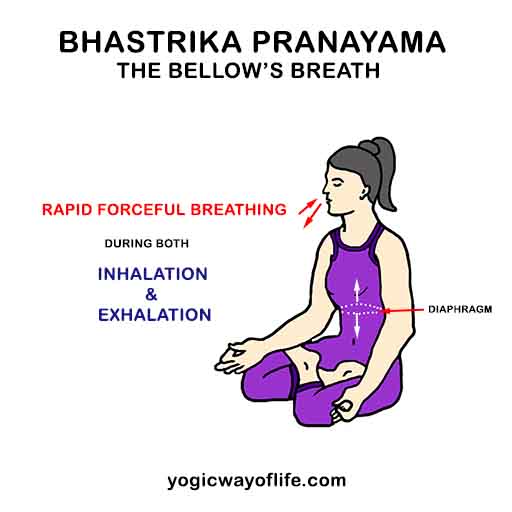
Bhastrika Benefits, How to do and Precautions

Bhastrika Kriya help in reducing the impurities of the body through forceful breathing. Focus on the movement of the stomach and Chest.


Note: While breathing in expand the chest and stomach and contract while breathing out.

Bhastrika How to do:

Breathe in and breathe out through both the nostrils in quick successions.

Chandrang Bhastrika  How to do:

Close the right nostril with the help of right thumb. Breathe in and breath out through the left nostril in quick succession.

Suryang Bahastrika Jow to do:

Close the left nostril with the help of right ring finger. Breathe in and breathe out through the right nostril quick successions.

Sushumna Bhastrika How to do :

Alternatively changing the nostril breathe out and breathe in quick successions.

Benefits of Bhastrika

It helps in eliminating the impurities of the abdominal and chest areas and especially the lungs.


Sunday, April 28, 2019

What is the most common mistake people make in their breathing?

One of the most common mistakes people make is breathing shallowly. Humans are born to breathe deeply, a process some times referred to as abdominal breathing. If you watch a sleeping baby, you will notice that its stomach rises and falls with each breath. As we grow older, many of us lose this innate ability to breathe deeply, and we end up breathing into only the top portion of our lungs.

Deep breathing is inhaling into the depths of our lungs. When we breathe deeply, we breathe into the entire length of our lungs. Shallow breathing is inhaling air into only the top portion of the lungs. When we breathe shallowly, we leave the lower portion unused and therefore limit the lungs fully potential

When we use the term abdominal breathing to describe deep breathing this not mean that inhaled air actually flows down into your abdomen. Ti simply indicates that you involve your abdomen when you breathe deeply, and you may get the impression that sir is filling up your lower abdomen. What you are actually doing is using your abdomen to cause the lowering of your diaphragm in order to extend the capacity of your lungs. Shallow breathing is one reason you frequently hear older people complain about having trouble breathing. It is never too late to learn and improve.

An ancient adage says that partial breathing is partial living. This wisdom goes deeper than just the inhalation of sufficient oxygen. A person who breathes partially, or shallowly, throughout life never know the higher level of existence that comes from living with the abundance of both oxygen and Chi energy. Chi the inner vital energy upon which Chinese medicinal practices and martial arts are based can be channeled to a location in the body to nourish or to heal or to soothe. This soothing effect can ease aches and discomforts, and it can lull a person to relax and sleep.

Concentrating the mind through breath awareness

There are so many techniques available for improving the concentration of mind. Breath awareness is one of the best ways to improve concentration.


Steps of Concentrating the mind- through breath awareness


Each of the following steps should be practiced for 2 to 5 minutes.

  1. Either sitting comfortably or lying, slow and deep breath is inhaled and exhaled in a natural way. The touch of breath should be felt on the skin inside the nostril while inhaling and exhaling.  This should be felt continuously for a few minutes.

  2. The coolness should be felt in the nostril while inhaling and the warmth while exhaling. The cool and warmth feelings should be continuously felt inside the nostril for some time.

  3. While breathing in, it should be felt that the body is being energized by the Oxygen that is inhaled and while breathing out, it should be felt that the impurities of the body and mind are sent out in the form of Carbon di Oxide. The practitioner should feel that his body is energized and the mind and body are purified with every breath continuously for some time.

  4. The divine bliss should be felt entering inside while inhaling the breath and while exhaling it should be felt that, the pains sorrow, diseases, agony, and tension are being eliminated. One should feel happiness and oy being inhaled and all problems exhaled with every breath continuously for some time.

  5. While breathing, it should be felt that the noble-satvika qualities such as love, affection, friendship, kindness, sympathy etc. are being further developed and while breathing out, the negative tendencies such as anger, lust, passion, hatred jealousy, ego etc are being eliminated from the mind. Thus with every breath, one feels that he is becoming a better person.

  6. While inhaling, the mind should follow the breath, through the nose, throat, windpipe and deep into the lungs. Similarly, while exhaling, the mind should start from the lungs, pass through the windpipe, throat, and nose and go out of the body. The mind should follow the breath, continuously for some time.


Practicing the above six processes, it should be tried gradually to acquire efficiency in them in a few days. It may take generally 3 to 4 days. Each process is to be practiced 2 to 5 minutes in the beginning. After succeeding a little in the first, the second may be taken up so-on.

Each of the above processes should be treated as complete and independent ones. One or two or all may be practiced, wherever and whenever one gets some leisure time.

The main purpose of the above  activities is to make the practitioner efficient in

  1. Using his time in a better way for a good cause.

  2. Developing concentration.

  3. Making meditation techniques easy.

  4. Giving up the ill thoughts.

  5. Reducing the depressions and anxiety in the mind.

  6. Strengthening the welfare and good thoughts etc.


Wednesday, April 10, 2019

Vajroli Mudra ,Benefits, How to do, Duration

Vajroli Mudra has many advantages. It stimulates the flow of energy to the sexual organs and cures premature ejaculation. In addition, men and women can enjoy sex for longer.


Do you want more sexual energy?


Vajroli mudra


Maybe you just want really healthy sex organs. This mudra will help you. And there are other mudras that help. Read about Linga mudra for improving male sexual stamina.

Also, read my book complete hand mudras to know more about mudra.


What are the advantages of Vajroli Mudra?


This mudra has numerous advantages. Let's have a look.

Benefits of Vajroli Mudra


Like Ashwini Mudra, This can be used to improve sexual health.

It is used to stimulating the flow of energy to the sexual organs.

Therefore, it offers many advantages.

  • Stop premature ejaculation.

  • Cure erectile dysfunction.

  • It makes the sexual organs much stronger.

  • Increases sexual longevity

  • Help with diseases of the urinary tract.

  • It helps with many other health complications.

  • Help activate all the chakras.

  • Use these healing mudras to get even more benefits.

  • The above benefits occur at the beginning of the practice.


This mudra becomes more powerful after years of training. At this point, it actually becomes an important tool to achieve enlightenment.

Interesting, right?

Also, read Mudra for Sexual debility 

How can you take This Mudra to enlightenment?


In essence, yoga systems explain that sexual energy is one of the primary energies. Vajroli Mudra stimulates the sexual energy that affects all our energy.

Through the practice of Vajroli Mudra, sexual energy can be channelled into the body. By transmitting energy upward, it flows through the brain and through the chakras, activating each chakra and leading to enlightenment.

The advanced stages of the Vajroli mudra are called Amroli and Sajroli. These steps can be found in yoga texts, although it is unlikely that most people will reach this stage of development.


Saturday, December 22, 2018

Dhavani Yog


Position: Sit in Padmasana or Sidhasana with hands is Gyanmudra position and elbows slighly bent, make sure spine is straight, shoulders level, head extension of spine .i.e erect, eyes closed and face calm.


Procedure:Breath normally for a few moments. Concentrate on breathing. Now inhale deeply and slowly filling the interior from sahasrara chakra to Mooladhara Chakra. While exhalling slowly two syllables of OM. i.e O &M are to be pronounced. The sound is to be divided in two parts of timind ratio 2 &1 i.e 2/3 part of time pronounce 'O' & 1/3 time M.


Concentrate on sound, slowly exhale pronouncing O for 2/3 of time exhalation and imagining sound travelling from Mooladhara Chakra to Anaahata chakra through Sushumna along spinal cord. At this stage close the lips and pronounce M for 1/3 of time of the exhalation. The sound will be like that of humming of a honeybee. Imagine this sound travelling along imaginary line uto sahasrara Chakra and complete the exhalation as much as you can.


Adavantages: This is the basiuc sound calming nervous system and mind, improves concentration and activates spinal cord. It is very helpful in exciting Agya Chakra.


Friday, November 24, 2017

Amazing Health Benefits Of Oiling The Navel

health benefits of oiling the navel

Oil of the navel is an ancient practice that has been lost in the frantic pace of a modern day. The navel is considered to be an essential center of the body in physical and spiritual health practices such as yoga, tai chi, and qigong. There are more than 72,000 nerve endings behind the belly button. Besides the navel, the pelvic floor is the only other body point with similar nerve endings. The stimulation of the navel through lubrication eliminates dryness in the body and is useful for the treatment of various conditions.

Oil the navel is a simple exercise. Take 3-4 drops of the recommended oil and massage for 5 minutes and around the navel, rub the excess oil with a cloth after the massage. The best time for this is after a bath or at bedtime.

The three incredible benefits of oiling the navel are

Lubricating the belly button with mustard oil soothes dry lips and chapped skin. You will notice a new glow within two weeks of starting this exercise.

Grease the navel with coconut oil or cow's milk Ghee (clarified butter) helps with vision problems, dry eyes, dry skin and brittle nails. Fat with ghee is incredibly useful in treating an umbilical hernia in babies. It takes less than a week to heal an umbilical hernia with this method; Pediatricians will not have a practical solution to treat umbilical hernias from now on.

Oil the navel with castor oil to relieve joint pain.
The oil used to grease the navel must be extracted by the natural method of cold pressing; The long-term benefits arise from the long-term use of lubrication technology.

Monday, January 9, 2017

Yoga And Psychology

Yoga And Psychology

  1. Yoga psychology as a basic science


Yoga psychology is both a positive and a normative science. As such it not only analyzes human personality and its growth, but sets normative ideals and prescribes techniques to achieve such objectives. Expansion of consciousness and making oneself the master of one's mind are the broad objectives of yoga psychology.


The topographical aspect of mind as described by Freud, towards the end of the 19th century, in terms of conscious, subconscious and unconscious levels, was well-conceived in yogic literature thousands of years ago. It also emphasized that the vast area of our mind was unknown and dormant, which was called the level of nidra or sushupti (deep sleep). Going a step ahead, yoga accepts the fourth level – turiya, i.e., transcended consciousness or the superconscious mind. When the mind reaches such a height of sadhana, cognitions do not remain dependent upon the senses, the individuality is transcended, and the mind acquires equanimity. This is called awakening of the superconscious mind.


The psychodynamic aspect of the mind has been described in terms of the id, ego and the superego. Psychoanalysis emphasizes that in order to live a normal life, an optimum strength of ego is a must to counterbalance the forces of the id, ego and superego. It underlines that too strong an id makes a person impulsive and sociopathic, and that too strong a superego makes him mentally ill. But what happens when the ego becomes very strong and dominant? According to yoga psychology, in such a condition the individual becomes egoistic and develops ahamkara (pride) which is the root cause of all psychosomatic problems.


This brings to the forefront the concept of the evolution of the mind as conceived in yoga psychology. Consciousness has a wider connotation in yoga. It may be sensorial, intellectual or psychic. Sensorial consciousness is based on sense experiences, whereas the intellectual consciousness is based on cues and their interpretation through the intellect. On the other hand, the psychic consciousness refers to the extrasensorial awareness and parapsychological experiences. Yoga presents vivid and sound meditation procedures for the attainment of this psychic consciousness or superconscious mind through the awakening of kundalini. The awakening of kundalini takes place through gradual activation of the seven chakras (psychic centres). They are mooladhara, swadhisthana, manipura, anahata, vishuddhi, ajna and sahasrara. The literature prescribes the conditions, precautions and methods of sadhana for stimulating the chakras and awakening the kundalini. Awakening of the dormant 90% of the mind and union of the kundalini shakti awakened in mooladhara with the pure consciousness of sahasrara is called self-realization. This evolution of mind through yogic sadhana is a gradual process. It brings balance and harmony in the personality and makes life blissful.


It is only recently that there has been a global interest in the quality of human life and psychological well-being. Psychological well-being has been conceived of by the psychologists in terms of happiness and satisfaction or gratification subjectively experienced by the individuals (Okun & Stock, 1987). This affective reaction of satisfaction need not be positively related to the objective conditions of life. One may be dissatisfied with life inspite of having plenty of material and family richness (Lawton, 1983). The psychological or subjective well-being is more a question of our own attitude and approach to life situations and events. Freedman (1978) has shown that cognitive processes such as aspiration, social comparison and adaptation level have much to do with it.


Long ago yoga psychology emphasized the role of positive cognition, thinking and approach for achieving pleasure and satisfaction in life. Yogic practices reduce negative thinking and negative emotion. Bhakti yoga and Ishwarapranidhana of raja yoga provide the useful techniques of dedication to God and offering prayers with a feeling to help build positive attitudes and self-confidence. The practices of shiva bhavana and maitri bhavana as described in Yoga Vashishtha are good techniques for combatting stress, anxiety, apprehension and hostility. Their psychotherapeutic significance has been established by a number of studies conducted earlier in Kashi Manovigyanshala at Varanasi. The SWAN model presented by Paramahamsa Niranjanananda is a good cognitive technique of self-appraisal. The four letters of SWAN refer to the Strengths, Weaknesses, Ambitions and Needs of individuals. They provide objective criteria of self-appraisal and parameters to evaluate progress in self-awareness and satisfaction.


The modern cognitive approach to life was well understood in yoga psychology. In the second sloka of his Yoga Sutras Patanjali defined yoga as control of the chittavrittis (modifications of mind). He mentioned the following five vrittis or cognitive modifications of mind. They are:


(i) Pramana – proof or valid cognition,

(ii) Viparyaya – illusion or invalid cognition,

(iii) Vikalpa – objectless verbal cognition,

(iv) Nidra – sleep or absence of all distinct cognitions, and

(v) Smriti – memory or recollection of past cognitions.


These vrittis, when related to narrow worldly gains and losses, become sources of affliction or pain and are called klista vrittis. But they can be transformed into aklista vrittis by making them positively and spiritually oriented. Patanjali has mentioned two broad methods of controlling the vrittis. They are (i) abhyasa (practice) of meditation and other yogic practices and (ii) vairagya (detachment).


The cognitive mental modifications of klista nature lead to pain and misery. Yoga psychology has enumerated five such basic distresses known as pancha kleshas. They are (i) avidya (ignorance or nescience), (ii) asmita (egoism), (iii) raga (attachment), (iv) dwesha (hatred) and (v) abhinivesha (fear of death). Patanjali has given an elaborate description of these kleshas and has underlined that avidya or false notion lies at the root of all other distresses. Avidya does not mean absence of knowledge, rather it means looking for wrong actions and ideas, which ultimately gives pain.


These kleshas give rise to various psychological and psychosomatic problems. Yoga psychology explains them and their management on the basis of the attachment-detachment model of mental health. Asakti (attachment) and vairagya (detachment) are the two extreme points on the same scale of a continuum with anasakti (non-attachment) being in between the two. Asakti means attachment with worldly affairs and things. Literally, it means narrowing the area of consciousness. This leads to raga, dwesha and ahamkara which manifest as insecurity, possessiveness, aggression, anxiety, depression and other mental and psychosomatic problems. Vairagya is the height of the nivritti way of life which is too difficult to be achieved by normal householders. It is the ideal mode of life set by the saints and rishis. Yoga psychology prescribes anasakti as the middle path to enjoy lasting happiness and peace without being involved and disturbed by asakti. An elaborate description of the asakti-anasakti model of mental health has been presented by Bhushan (1994).


As regards methods of study, looking within is the primary method of understanding yogic experiences. This is different from the ordinary method of introspection used in psychology. Visualization, awareness and witnessing the images in a neutral manner with drashta bhava are the keys of yogic meditation and sadhana.


The principle of homeostasis or balance is central in yoga psychology. It holds that any sort of imbalance in the physical, psychological or pranic system creates problems and disorders and the cure lies in rebalancing it. Another scientifically sound concept is acceptance of individual differences. Yoga psychology presents a clear description of different types of human personality and prescribes different yogic practices for them. The most important one is based on the three gunas of sattwa, rajas and tamas. These gunas are largely acquired and so through them a desired transformation in attitude and personality is possible by yogic practices.


  1. Yoga psychology as an applied science


The relevance of an academic discipline lies in its utility and application in finding solutions to the problems facing the individual and society. From this viewpoint, yoga psychology has special significance. Some of the issues and areas in which it has important applications are mentioned below.


  1. Promoting health


Yoga believes in total health. But it does hold that health has three integrated aspects, i.e., physical, psychological and spiritual. We cannot think of good health by taking care of one aspect and ignoring the other ones. The fact is that if we ignore the mental or the spiritual aspects, physically also we cannot remain healthy. Each aspect of health influences the other. Total good health means physical fitness, mental ability and spiritual verve. Yoga stands for both physical and mental well-being and higher spiritual attainments. Thus it presents a wider spectrum than the modern viewpoint of psychosomatics. Good illustrative books are now available which discuss in detail the possible effects of yogic asanas, pranayamas, pratyahara and meditation techniques on the body, mind and expansion of consciousness (e.g. Swami Niranjanananda Saraswati, 1993; Swami Satyananda Saraswati, 1996; Motoyama, 1979). Tracing the link between yoga and oriental medicine has concluded that yoga is based on the holistic knowledge of different aspects of a person's being.

A good number of studies have established the beneficial effects of meditation and other yogic practices in managing anxiety (Jangid et al, 1988; Sharma & Agnihotri, 1982), depression and other types of neurotic disorders (Jaug, 1975; Nagarathna & Nagendra, 1980). They have been found equally useful in treating stress-related psychosomatic disorders like diabetes (Divekar, 1982), tension headache (Sethi et al, 1981), hypertension and schemic heart (Swami Karmananda Saraswati, 1982; Ornish, 1990). Studies have been conducted to examine the effects of yogic practices on neural functioning, including the ANS and brain waves (Ramamurthi, 1977; Varma, 1979). However, more well-designed experimental research is needed to examine the physiological basis of the different yogic techniques. Similarly, the psychotherapeutic use and rationale for the effects of specific asanas, pranayamas and meditation techniques, like antar mouna, ajapa japa, chidakash dharana, etc. needs to be confirmed through planned experimental studies. There is also the need to review and integrate the findings of research conducted at a large number of centres in different places.

According to yogic theory, diseases develop because of imbalance in the psychosomatic and pranic systems. The yogic practices restore the balance and remove the toxins from the nadis and the body systems. The same practices help build a defence against disease and promote healthy living. The practice of hatha yoga has special cleansing and balancing effects on body and mind.


  1. Developing positive attitudes and feelings


Everyone wants to be happy and to enjoy life, but because of our faulty approach and negative feelings we often carry fear, apprehension and suffer agony in life. Verma (1988) has proposed a dual factor theory of mental health according to which the factors or conditions contributing to positive and negative mental health are different. As such, the absence of certain factors contributing to negative set and health does not lead to positive mental health. Yogic practices help develop psychological well-being by providing the insight to perceive positive aspects in individuals and events, thereby developing positive affect, pleasure and satisfaction. Understanding and practising the principles of karma yoga reduces the magnitude of expectation and consequential frustration.

A study conducted recently under the guidance of Swami Niranjanananda Saraswati (1996) by the extension wing of Bihar Yoga Bharati, Munger, on a total of 1140 prisoners of 24 jails in Bihar is worth mentioning here. Yoga training was provided to the convicts in three spells, each of 15 days duration. Pre and post comparison of data indicated that the prisoners who participated in all three programs reported as physically fitter and mentally happier. There was a substantial reduction in their negative emotions such as anger, anxiety and depression, as well as in interpersonal conflicts. Better sleep and mental peace were also reported. Ninety-six prisoners who were addicted to tobacco and smoking bidis took a sankalpa (resolve) to give up the habit, and surrendered their tobacco, bidis, etc. to the yoga teacher. To what extent the psychological and behavioural modifications are sustained is the subject of a follow up study which the Institute is carrying out. Encouraged by the results of the yoga training, the Government of Bihar has taken a policy decision to introduce yoga training in all the 82 jails of Bihar on a regular basis. With this objective, 136 life convicts, selected on the basis of their yogic skills and aptitude, have been given Yoga Teachers Training Courses by qualified sannyasins of Bihar School of Yoga, so that they may now act as yoga teachers to provide yoga training in the jails on a regular basis.


  1. Improving concentration, abilities and skills


Most of our problems in life are on account of cortical excitations, and the flickering and fluctuating nature of the mind. Selected yogic practices enhance the mental alertness, creative ability and learning capacity of individuals (Swami Muktananda Saraswati, 1982). This has received support from the recent findings of a research report undertaken on young scientists by Shelvamurthy (1996). The results indicate that, compared to the control group, the experimental group of young scientists who were given yoga practices performed better in concentration, memory, cognitive management of situations, stress management, coping with hot and cold conditions, etc. Such findings provide a basis for the introduction of yogic practices in different training programs. The initiative taken by the Central Government and many State Governments to introduce yogic training for school students is in the right direction.


  1. Promoting a congenial organizational climate and work proficiency.


Recent experience of introducing yogic practices in management programs shows that it may serve as a good relief in reducing organizational stress and in promoting a congenial work climate. The practice of yoga nidra, certain selected asanas, pranayamas and meditations are useful to relax and quieten the mind (Bhole, 1981; Datey, 1978; Singh et al, 1978). They can be conveniently introduced in an organizational setup to promote alertness, congenial feelings, job satisfaction and work proficiency.


  1. Combatting social problems.


Certain studies like that of Kaul (1993) have shown that selected yogic practices are beneficial in managing drug addiction and alcoholism. Similarly, violence, group conflicts and prejudices prevail in society mostly on account of ego problems and emotional instability. As stated earlier, since the yogic practices are capable of reducing aggression and negative feelings, and are helpful in quietening the mind, they serve as important tools to combat many problems. The experience of conducting yoga programs in jails (referred to above) provides convincing data on positive transformations in feelings, attitudes and expectations of the convicts in the jails and improvement in their interpersonal relationships. The principles of yoga psychology can, therefore, be used as corrective measures for promoting desirable social behaviour and minimizing many social problems based on distrust and hatred. The yogic literature says that a predominance of tamas, which often creates social problems, is minimized and transformed into rajas or sattwa dominance by yogic practices. This theoretical assertion needs more experimental verification and proper application.


  1. Promoting the self.


Yoga is not only a curative and preventive measure for diseases and social maladies, but also a promotive science of the human personality. The practice of meditational techniques brings a qualitative change in human personality and they are capable of taking the self to a higher level. Expansion of consciousness, development of extrasensorial capabilities and samabhava, coupled with feelings of non-attachment are some of the characteristic features of a realized person. The self at this level of psychic development is called 'sarveshwar'. This is a blissful life in which individuality is transcended and the mind acquires complete equanimity.


Conclusion


In short, yoga psychology has important applications in managing psychological, psychosomatic and social problems as well as in promoting and transcending the self. It provides theoretical models and practical tools and techniques for their verification. However, many of the observational and theoretical assertions need experimental verification and re-interpretation in a changed context. Selection of yogic techniques for different purposes and individuals is a difficult task. It demands a long-term, detailed plan by devoted individuals and institutions. The cooperation of all those psychologists having an interest in the area is solicited.

Friday, October 28, 2016

Why you should go for yoga workout ?


Why you should go for yoga workout ?

Yoga workout is considered to be one of the most enduring exercises programs. It works more than jus toning the muscles and burning the calories. It assists in strengthening the body as well. It assists in deep breathing and confers relaxation to mind as well. There are different kinds of yoga workout which are beneficial to a person.


Benefits of Yoga Workout


Yoga workout is highly beneficial for you if you are suffering from diabetes. This workout assists in preventing the level of high cholesterol or high blood pressure in the body. It also reduces the risks of cardiovascular diseases. It confers flexibility, strength, and awareness of body and mind. If you have problems of arthritis, yoga workout helps you in staying strong and flexible without putting additional stress on the joints. It boosts energy levels of the body. It also renders relaxation to mind. These workouts are beneficial in keeping the body in shape.


Areas It Targets


The yoga workout targets different parts of the body which are inclusive of arms, legs, back and glutes. You can enhance the strength of arms by practising yoga workout on a regular basis. You can procure relief from a soring back with the aid of yoga workout. The workout works effectively on different sides of the legs such as thighs, hips, and quadriceps.


Yoga workout plays an indispensable role in improving flexibility. It is considered to be one of the well renowned aerobic exercises that are beneficial in improving health. It helps in holding the body in a well-balanced pose. People of all ages can get benefitted by these exercises. Some of the most popular yoga workout are inclusive of Hatha, Vinyasa, Power, Ashtanga, Bikram, Iyengar. These exercises have been highly preferred by people for more than 5000 years ago. It is recognized to be an accomplished workout of body and mind.

Friday, October 7, 2016

Ubhaya Padangusthasana (Both Big Toes)

Ubhaya Padanguthasana


It is also called as "Both big toes pose." Meaning of Ubhaya Padangusthasana is given below;


The meaning of  Ubhaya is both; Pada means foot and Angusthasana meaning is big toe.  In this yoga pose, you have to take both of your big toes with both of your hands.  You have to enter this yoga pose from an inverted posture with a roll; the rolling motion may have to take the time to “master” be patient with the procedure and remember to focus your breath, in time you will feel the movement and roll up smoothly to the balance.

How to do Ubhaya Padangusthasana


First of all, you have to lie down on the back, then move the hands beside the body

and legs stretched. Inhale and raise the body up
in Sarvangasana. As you exhale, keep the toes
above the head and don't bend the knees
( Hala Sana posture) . Hold the big toes with
respective hands. Inhale, come up and
balance the body on hips keeping knees
straight. Take a few normal breaths. Exhaling,
roll back to Hala Sana posture. Inhaling, lift the
legs to come to Sarvangasana. Now exhale and
come back to normal lying posture.

Benefits of Ubhaya Padangusthasana:

1.Prevents a hernia.
2.Relieves severe back ache
3.Tones abdominal organs
4.Improves digestion
5.The pelvic organs receive a rich supply of blood.
6.Helps in building concentration.

Precautions

women should not practice it during pregnancy and menstruation.

Bridge Pose ( Setu Bandhasana)

Bridge Pose Yoga pose
The Health Benefits of
Setu Bandhasana
(Bridge Pose)

...
Benefits of Bridge Pose:

1.Stretches the chest, neck, spine, and hips
Strengthens the back, buttocks, and hamstrings
2.Improves circulation of blood
3.Helps alleviate stress and mild depression
4.Calms the brain and central nervous system
Stimulates the lungs, thyroid glands, and
abdominal organs
5.Improves digestion
6.Helps relieve symptoms of menopause
7.Reduces backache and headache
8.Reduces fatigue, anxiety, and insomnia
8.Rejuvenates tired legs
9.Relieves symptoms of asthma and high blood
pressure
10.Therapeutic for hypertension, osteoporosis,
and sinusitis.

”Setu Bandha”
means
“the
construction of a bridge.” So, in Setu
Bandhasana (14* on Iyengar’s 60* scale of
difficulty), your grounded feet and head are
meant to resemble the foundations upon
which the arch of a bridge is built.
Before you can build the bridge of this yoga
pose, though, you must start with a solid
foundation. In my case, I have much work
to do on strengthening the fundamental
aspects of the asana before I will be able to
lift into this challenging backbend. I do not
have the neck strength or neck stability to
lift into the full pose. I also will need to
develop spinal flexibility to help approach
this pose down the line. In order to do Setu
Bandhasana, you must have a strong ability
to backbend through all areas of your spine:
cervical, thoracic, lumbar, and sacrum
— with

Lotus pose in peacock pose (Padma Mayurasana)

Padma Mayurasana


It is also known as "Lotus pose in peacock pose." Padma Mayurasana is done by first assuming the Padmasana and then doing the Mayurasana. It is an advanced yoga asana. It requires a real strength of the arms and the abdominal muscles along with a good sense of balance.

How to do Padma Mayurasana


First of all start with; Padmasana... then
1. Place your palms on the front after inverting your
fingers (the fingers are pointing towards your body
and wrists are to the front. Fingers should be well
spread.
2. Shift the weight of your body on your hands by
raising padmasana slowly.
3. Keep the torso horizontal.

Benefits Of Padma Mayurasana


1. As per Mayurasana but balancing is easier.
2. Helps to stimulate Metabolic process.
3. Contributes to increasing in secretion from different organs.
4. Stimulates elimination of toxins from the blood.
5. Removal of skin conditions such as boils.
6. All the digestive organs are get massaged.
Intestinal peristalsis is stimulated.
7. Treatment of flatulence, constipation, diabetes,
sluggishness of liver & kidneys.
8. The endocrine system is balanced.
9. All muscles of the body are strengthened.
10.Toxins and impurities accumulated are burnt.
11.The three doshas are balanced.

Precautions:


If you have any of the following disorders please don't try this; High BP, hernia, heart disease, any type of
ulcer, physical weakness, pregnancy, weak
wrists and arms.

Standing Forward Fold (Uttaanaasana)

Standing Forward Fold
:
Ut is a particle indicating deliberation, intensity.
The verb tan means to stretch, extend, lengthen
out. In this AASANA, the spine is given a...
deliberate and an intense stretch.
BENEFITS OF UTTANASANA:
This AASANA is great for digestion, and should
be practiced by most people who suffer bowel
or stomach pain disorder. This AASANA cures
stomach pains and tones the liver, the spleen
and the kidneys. It also relive stomach pain
during menstrual periods. The heart beats are
slowed down and the spinal nerves rejuvenated.
Any depression felt in the mind is removed if
one hold the pose for two minutes or more. The
posture is a boon to people who get excited
quickly, as it soothes the brain cells. After
finishing the AASANA, once feels calm and cool,
the eyes start to glow and the mind feels at
peace.

Hasta Uttanasana (Raised Hands Pose)

Hasta Uttanasana also known as "Raised hands pose." It is also the 2nd and 11th poses of the Surya Namaskar.

How to do Hasta Uttanasana


First of all,  you have to inhale and stretch the body. This has to do by raising your hands above head. Then try to pull the ribs and
the upper organs upwards. Also, the back takes
the weight of the body momentarily which
strengthens it. Usually, this yoga pose  is done during the
Surya Namaskar practice,since it is in
the sequence of poses as it is easier to bend
forward from this pose.
Benefits of Hasta Uttanasana:

1.In this yoga pose your body is stretched above, it helps to relax the neck and back muscles.
2.  Your abdomen is stretched it also get the organs are
massaged.
3. The shoulders become stronger, and it is
useful in the treatment for frozen shoulders condition.
4. The spinal cord and the back bone are also
stretched and helped in curing various back
problems.
5. Thyroid gland gets affected which helps in
fighting obesity.

Precautions

There is no serious problems with this yoga pose.

ARDHA SALABHASANA


Ardha Salabhasana


The Ardha Salabhasana has also known as " Half Locust Pose."

The meaning word "Shalabh" is  'locust' and "Ardha"...
means 'half'. This yoga pose is an easier version of
Shalabasana. Performed with one leg at a time.
The final posture of this yoga pose  resembles a feeding locust,
Head lowered and tailed up. Helps to lose a few inches here and there with Ardha

How to do Ardha Salabasana


When we gain the weight, the first place where
most us put on, is on the thighs and then
on hips. Most of the time large hip measurements are
a result of sedentary habits. If you are sitting for
extra long hours at a stretch, whether due to your work
or as a matter of habit may also end up
with a thick bottom. Extra inches on the hips
can make the body look ugly, which
is why it is necessary to lose excess fat
around the hips for a perfect figure.
Although it is quite normal to gain weight on the
hips and thighs. Losing fat at these places is hard.
When women try to lose weight by
dieting they normally lose it in the following
order: Face, bust, waist, stomach, hips and
thighs. It can thus be seen that to lose inches on
the hips, it is important not to depend upon
dieting but to change certain habits and to get
Proper exercise. Many yoga asanas can be
useful for this purpose. One of these
postures is Ardha Salabhasana. Which along with other
benefits helps in tightening the buttocks and
reducing the size of the hips.
Ardha Salabhasana is an elementary form of
Salabhasana. It is an active posture. It is very
suitable for beginners and should be mastered
before trying Salabhasana.


Benefits of  Ardha Salabhasana


1. This posture is excellent for tightening up the
muscles around the hips and thereby reducing
them.
2. It gives good exercise to the abdomen; it
activates the kidneys, liver and strengthens the
ovaries.
3. This posture gives a backward bend to the spine
and benefits the lower part of the spine.
4.It is useful in extricating waste matter
accumulated in the intestines.
5. It helps in curing constipation, gas troubles,
indigestion, dysentery, acidity and other
abdominal disorders. *Regular practice of this
asana helps in the prevention of piles

Precautions

Anyone can do this nothing to worry for trying this yoga pose.

Vatayanasana

Vatayanasan


It is also known as " Horse pose." The meaning of Vatayana  is "horse". This yoga pose resembles a horse's face.

This yoga pose resembles a horse's face.
“Vat” means arthritis and this yoga is ...
beneficial in arthritis and other knee problems.


How to do Vatayanasa


  • First of all, stand up straight and then bend the right leg upwards at the knee so that your heel of the right foot is touching the groin and the toes are placed along the base of the left thigh.

  • Now bend the left knee so as to lower the lower body till the folded right knee is resting on the ground.

  • You are now standing on the left foot and right knee.

  • Raise both the arms and bend the elbows so that the forearms are pointing upwards.

  • Keep the left elbow in the crook of the right elbow and entwine your right forearm around the lower left arm.

  • The palms of the hands should be together in a namaskar position.

  • Hold this pose for one minute and then return to your normal position.

  • Repeat the pose on the opposite side, standing on the right foot and left knee.

  • This completes one set. Repeat the set twice.


Benefits of the Vatayanasana
1.Help keep celibacy.
2.Also, contributes to curing diabetes and strengthens the calves, knees, waist, spine, and neck.
Effects of Vatayanasana
In this pose, the hip joints receive proper
circulation of the blood and minor deformity in
the hips and thighs is corrected. The pose is also
good for stiffness in the sacroiliac region.
extremely

VRKSASANA

Vrksasana


The pose gives an upward stretch to your body.
And is a good yoga posture to use if you are...
Introducing the  body to the art of balancing.
Benefits of  Vrikshasana
This yoga pose leaves you in a state of rejuvenation.
It stretches the legs, back and arms, and
invigorates you.
It brings balance and equilibrium to your mind.
It helps improve concentration.
This posture has been found to relieve some
cases of sciatica.
It makes the legs strong, improves balance, and
opens the hips.
Contraindications of the Tree Pose (Vrikshasana)
Avoid doing this posture if you are suffering
from a migraine, insomnia, low or high blood
pressure (those with high blood pressure may do
this pose but without raising their hands
overhead, as this may further raise their blood
pressure).

Chandrasana, Benefits, How to do, Precautions

[caption id="attachment_33000" align="alignnone" width="1024"]Chandrasana Chandrasana[/caption]


It is also known as "The Crescent Moon".The Pigeon is used as
Preparatory exercises for Hanumanasana(the...
splits).

These postures are not always considered
to be a spinal twist, but they do involve a twist in
the lumbar spine to hold the back leg
behind the body, while aiming to keep the hip
as square as possible.


Benefits  Of Chandrasana


1. Stretches, kimbers and tones the legs and hips.
2. Relaxes the adductor(goods thigh) muscles.
3. Increases the blood supply to the colon on
the side where the leg is forward. This helps peristalsis and elimination.
4. Can prevent and relieve sciatica.


Precautions and contraindications.

These are some precautions you should take into account before using Anjaneyasana.

Avoid this asana if you have the following problems:
a. hypertension
b. knee injury

c.If you have shoulder problems, do not raise your arms above your head. Instead, you can put your hands on your thighs.

d.If you have a neck problem, do not look back. Instead, put your gaze forward.

e. Do not bounce while holding or moving into
the crescent moon.

f. Do not over-stretch in this posture, as you
may pull or strain a muscle.

g. Try to keep your spine extended and your hips
as square as possible throughout

[caption id="attachment_33001" align="alignnone" width="1024"]Cresent Moon pose Crescent Moon Pose[/caption]

Tips for beginners


As a beginner, it can be difficult to balance your body's posture. Imagine this asana of the wall to improve your balance. When you advance, make sure your fingers touch the wall.

To complicate this asana, try to close your eyes if you take that asana once you have confidence in it. This will help you improve your balance.